Showing posts with label Tracks. Show all posts

Tuesday, June 28, 2016

Searching for Florida Panther Tracks

Looking for a good way to get the attention of airport security? Try bringing a half-gallon Ziplock bag full of an unmarked powder in your carry-on bag.
Agent: "Sir,what is this?"
Route 29, South Florida
June, 2016
 Me: "Plaster of Paris."
Agent: "And why do you have it?"
Me: "To make casts of animal tracks."
Agent: "What?"
She recommended next time I fly, I take it out of my daypack for easier screening...

I was heading to Tampa, Florida to attend a business meeting but had managed to arrange exactly 25 hours of free time before the opening session to head south and search for Florida panther tracks. That meant a three-hour drive each way once I arrived in Tampa. I sought advice before heading out on where to go. One spot that looked promising on a map was a highway underpass leading from Fakahatchee Strand Preserve State park to the Florida Panther NWR under I-75. My plan was to park to the south near what appear to be flooded quarries in the Northeast corner of "Fak" and hike the two-track to the underpass rather than try to drive the low-clearance rental car on any of it.
I arrived at the hottest part of a (to me at least) very hot and humid day. I have never been to Florida in June and everything appeared to my eye to be very wet. The trail quickly produced domestic dog tracks, similar in size to the panther tracks I sought, and this allowed me to brush up on my canine v. feline track ID skills.
I feel there is much misinformation regarding how to tell cat from dog tracks. For example, many people put far too much stock in whether they see nails or not. First, not all dog tracks show the nails and second, lay persons often do not recognize nails even when present. Consider the dog tracks I photographed only minutes into my hike:
Domestic dog track
Fakahatchee State Park, FL June, 2016
If you look closely at the track above, you can see the nail marks on the left side of the track but I cannot see them on the right side at all.
Domestic dog front (lower track) and rear (upper track) paw prints
Fakahatchee State Park, Florida June, 2016
I followed the trail largely with my head down looking for sign which is not the best way to stay aware of one's surroundings but perhaps a forgivable sin considering the singular purpose of this hike. The trail was a maddening mixture of wonderful muddy substrate followed by long stretches of difficult limestone bedrock. My eyes strained to find recognizable detail in this unfamiliar ground when suddenly a bird leapt up from my very feet. I instantly registered "goatsucker" (the common name for the family Caprimugliformes) as I watched it settle on the trail 15 yards ahead. But which species? It took to flight and the white wing patches confirmed Common Nighthawk.
Common Nighthawk
Florida, June 2016
Common Nighthawk
Florida, June 2016
 I pressed on. I knew from the aerial view on Google Earth that the trail would bend north ahead and i was prepared for the mud, brush and mosquitoes I was to encounter as the trail became less used and more narrow. What I was not prepared for was two feet of standing water. The water stretched as far as I could see and I had at least a half-mile to go before reaching the underpass. I considered continuing but realized that the underpass was probably underwater as well.
It was only a short drive to my next stop. Also in the northeast corner of "Fak" there is an unmarked road that ends at a gate. The road provides access to a few private inholdings and makes for a nice hiking trail for the public. By now it was late afternoon with temperatures and percent humidity still reading in the mid-90s. My glasses, camera and binoculars all fogged while making the transition from the air-conditioned car. I applied more sunscreen and donned my camouflaged bucket hat; the one I plucked from the Indian Ocean while snorkeling in Australia a decade ago. My pack was heavy with plaster, water, camera and field guide. But my spirits were light as I hoped for success.
Facebook friend, fellow blogger and all-around naturalist Janet Pesaturo had recommended this trail to me. She placed camera traps here in January and wrote about her results on her blog here. It didn't take long before I found my first set of tracks. And they were CAT TRACKS!
I guess I knew they were bobcat from the moment I saw them but I still carefully measured them and consulted my field guide. On page 208 of Elbroch's Mammal Tracks & Sign, the author states that the
Bobcat track
Florida, June 2016
heel (or palm or metacarpal) pad of a bobcat measures 1-1 9/16 inches while a panther would be larger. Since toes can sprawl, the heel pad is a more reliable measure than overall track width. These pads were just under 1 1/2 inches, not even at the high end of bobcat so my initial impression was confirmed.
What made me so certain these were feline? First, they show an asymmetry that canine tracks do not. Picture your four fingers without the thumb and you have the toe pattern of a cat. But there are other characteristics too. Look at the shape of each toe. They are nice ovals. The leading toes of most canines are oval but the outer toes of canines are not. Those toes have an inner edge that points toward the center of the track. Panther toe prints are compared to grapes in both size and shape.
Front right Bobcat track
Florida, June 2016
In addition to the toe shape, look at the heel pad shape. Canids have a single bump at the front while felids have two. Sue Morse's trick to remember this is to think of the double bump as the letter M for "meow". It works.

The thunder rumbling in the distance had been barely registering in my mind but as I looked up from the bobcat tracks I noticed an ever darkening sky. I decided to press on but 20 minutes later i saw that I could no longer ignore the incoming thunderstorm. I turned back and reached the car just as the first fat drops of rain began to fall.
The 15 minute drive to the motel in Everglades City was a wet one. It had been a rainy week before I arrived and I saw standing water in every parking lot. I grabbed some food to go and waited out the weather in my room.
A night drive after the storm produced lots of snakes but no mammals. The following morning I was back in my same parking lot at the gate ready to press on where I had to turn back the day before. I relocated the bobcat tracks and they showed that this spot was on the edge of last night's storm as the tracks had not changed much. I continued past the point I reached the day before and quickly found rodent tracks of both gray squirrel and what I believe were hispid cotton rat. A Barred Owl was hooting and I began to spot small alligators among the cypress knees. As I bent to inspect yet another muddy spot, my heart skipped a beat as I saw a clear tow print the size and shape of a grape! Then another. And another. And two more. Wait.... that makes five. My mind screamed "black bear" but I
Black Bear track
(Florida, 2016)
fought that identification with all my might. Surely this was to be my elusive panther! But it was not. One track became two, that became a short trail. Not a Florida panther for sure, but who can remain sad while looking at fresh bear sign.
I pressed on. I found more bear tracks. I birded. I softly grunted to the alligators, imitating the call of the young. I looked in vain for panther tracks. I was lost in thought when I realized I was hearing running water. Ahead the trail was blocked. My search had come to an end. Walking back, I discovered a camera trap, crouched down in front of it for a selfie, and sent Janet a Facebook message asking if it was one of hers. It was.
The drive to Tampa was long but uneventful. I decided I had to return to that trail when there was less water. That night after dinner, I found the passage I was looking for in Maehr's 1997 book The Florida Panther: Life and Death of a Vanishing Carnivore": "We were standing in the heart of the only place east of the Mississippi River where this combination of terrestrial carnivore species - panther, bobcat, and black bear - still live." I smiled at the thought that I had stood there too.


Monday, February 29, 2016

Unusual Bird Tracks

Algonquin Provincial Park East Gate
2/16, Ontario Canada
My wife and I recently made the 325-mile trip to Algonquin Provincial Park to do some wildlife watching and cross-country skiing. We succeeded in both. I have been focused on increasing my tracking skills lately and took the opportunity on this trip to study the trails of American marten, snowshoe hare and red squirrel. But it was the bird sign that we encountered that got me to write this post. I present here two "unusual" tracks.

When most people think of a track, they think of a footprint. But trackers know better. A "track" can be any number of evidence an animal leaves behind,

Ruffed Grouse tracks and body print
2/16, Algonquin Park
EXAMPLE ONE: Ruffed Grouse body print. While skiing the Pinetree Loop Trail, Laura and I spotted Ruffed Grouse tracks crossing the groomed trail. When the bird hopped/flew up from the hard packed trail onto the powdery shoulder, it left an imprint of its entire body as it landed. That impression, called a sitzmark by some, is a track just the same as the peace-sign footsteps that work their way through the snow.


Each step carefully placed before the last, these tracks always remind me of a zipper.
Ruffed Grouse tracks in snow
2/16, Algonquin Provincial Park
EXAMPLE TWO: Birds on a fence.Wherever we went in the Park, we seemed to encounter birds that were used to being fed. Black-capped Chickadees mobbed us at the end of a road.

Gray Jays are notorious for readily coming to the hand and these were no exception.
Gray Jay
2/16, Algonquin Provincial Park
We left the parking area and hiked for a bit looking for open water and signs of river otter. We ran out of time before finding much of either. A few inches of fresh snow provided an hours-old blanket that had wiped most of the slate clean. And when we returned to the parking area, the birds were there to greet us. And it was the very freshness of the snow that made me notice the gaps on the gate.

Each rail of the gate had patches of snow missing. Some of the patches were shapeless while others looked like the photo above: two slots. I remarked to Laura that they looked like legs. And the more I thought about it, the more I realized I was on to something. We stood back from the gate and watched as birds landed and made new gaps in the snow. These were in fact bird tracks! And we got to watch them being made.

The larger shapeless gaps were places where the bird landed multiple times.


In the photo below, a Chickadee lands in a new location on the gate.

And here are the tracks it left behind:

I was proud of myself for being observant and seeing these subtle signs the Chickadees were leaving behind. Tracks can be so much more than footprints.

Sunday, March 22, 2015

Mammal #29

I had set aside some time to blog today and was planning to whine about the snow. I had selected some rabbit and squirrel tracks to discuss, but those plans all changed once I checked my camera trap. I was going to check the camera on Friday, but got busy with other things. The story was the same on Saturday. But on today (Sunday), I had run out of excuses. You see, we had some chicken thighs I had to dispose of. They had been used as part of a lab by my wife's students. They were practicing suturing and the result for me was bait for the camera trap. I do not go out of my way to bait animals, but I was not going to let these go to waste. I cut out the sutures and chunked the meat into bite sized pieces.
Fisher tracks
(Seneca Falls, NY 3/15)
I am sure glad I waited. It is only a short walk from the house to the camera. The fresh snow obscured all but the most recent tracks. I followed a set of red fox tracks that must have been made only hours earlier as they had no snow in them at all. I arrived at the set, changed the SD card and dropped off the chicken. I decided that I should take a different route back. Almost immediately I encountered a trail that had been snowed in by the day's precipitation. I admit that I was a bit distracted at first and wrote the trail off as fox. But fox didn't fit, This was not a side trot as I had originally thought but rather a lope.
I am reading Animal Tracking Basics by Jon Young and Tiffany Morgan. They advocate looking at a trail or track and listing your three best guesses. So I gave that a try. My first thought was striped skunk (although I knew these tracks were way too big). My second critter was raccoon because coons can leave some really odd track patterns (but I wasn't convinced of that either). My third guess was the hardest of all. I kept telling myself these couldn't possibly be fisher. I have never seen a fisher on my property or even heard of one in the township. I do not have fisher habitat.
Here is another view of those same tracks. The sun was getting low in the sky and that provided
Fisher trail in a lope
(Seneca Falls, NY 3/15)
enough shadow to bring out the detail in these tracks. These had been protected a bit by the trees and had far less snow in them than the first ones I encountered. I bought the ruler in the photo from Sue Morse when I attended one of her tracking workshops. At that workshop, Sue described the toe pattern of a fisher as "C" shaped. I could see that clearly in three of the four tracks shown here. I was still a bit in denial that these were fisher tracks. It is interesting what the mind can do. I really wanted to turn them into something, anything that I would expect to find here in Seneca Falls. I kept telling myself they were fox or just some weird skunk tracks. But I just couldn't make anything else fit besides fisher. And in the words of Mr. Spock (who was paraphrasing Sherlock Holmes): "If you eliminate the impossible, whatever remains, no matter how improbable, must be the truth.". Who am I to argue with Spock (or Holmes for that matter)? But I did. I argued. I resisted. I have one more track photo to show you, the one that convinced me I just couldn't argue anymore.


Fisher tracks
(Seneca Falls, NY 3/15)
Here is as good a fisher track as I was able to find. I found it under the spruces. I learned that from Sue Morse as well. Sue told us several times during that weekend workshop to follow a trail until you found sheltered tracks that would show the details. Fisher like other members of the weasel family have five toes on the front and rear feet. You can make out all the toes in this photo.
I was very excited to say the least. This was the 29th species of wild mammal I have documented on our property (and the title of this entry). It is now one of four that have only been documented a single time (house mouse, beaver and star-nosed mole are the others).
So if I hadn't checked my camera today, I wouldn't have found these fisher tracks as the weather in the next few days will assure that they will soon be gone. But the story is not over. I returned home and slipped the SD card into my laptop. Skunk, deer, opossum, cottontail, and a few others appeared. There was the red fox who left the trail I originally followed. But my prize was there at the end. Any doubts I had about my identification of the tracks were laid to rest by several images of a fisher. The fisher tracks near the camera were obscured by the other tracks that were present and drifting and blowing snow. But once I knew where to look, I was able to find those tracks as well. None of the photos are spectacular, but I will include them here to complete the story.

Let me share two photos to set the stage and give you some scale. First, a striped skunk. Striped skunks are variable in their pattern and this individual is particularly white. Just below that is an opossum, very obscured by the vegetation. This camera only uses infrared flash at night so none of the photos will be in color.

Both are about the size of a house cat and both are in nearly the exact spot where the fisher was captured. Here is the first photo of the fisher. You can see that he is laying down tracks as the snow is busily filling them. This animal is clearly larger than the opossum or skunk.
Fisher
(Seneca Falls, NY 3/15)
Here is the second photo of the fisher. I include it here because it shows the tail so well.
Fisher
(Seneca Falls, NY 3/15)
Finally, the fisher walked so close to the camera that it only captured the top part of his body. I say "his" because I am pretty sure this is a male by size. Females are smaller (as is common in the weasel family).
Fisher
(Seneca Falls,NY 3/15)
What an exciting final day of spring break for me. I head back to classes tomorrow and begin the "Wildlife" section of CON 102 Introduction to Wildlife and Fish. This is a class that is required for all conservation majors at our college and the inspiration for this blog in the first place. I can't wait!

Wednesday, February 25, 2015

Winter tracking: Red Fox

This winter has been marked by a large amount of snow and long periods of below freezing temperatures. Although the temperature was only about 24F it was sunny and I strapped on the cross
Red fox
(Seneca Falls, NY 2/15)
country skis to retrieve one of my camera traps. Turns out there has been a lot of fox activity at that site, both red and gray. At right, a red fox noses under the snow for food.


Next, a gray fox appears after a fresh snow:
Gray fox
(Seneca Falls, NY 2/15)
Red fox leaving a trail in the snow
(Seneca Falls, NY 2/15)


I have been looking at animal tracks in the snow for years. Tracks and trails in the snow are often easy to identify. Up until recently, I have been focusing exclusively on the track itself. This winter, I have paid attention to the changes to the snow below the track. The weight of the animal compresses the snow, packs it down and makes it harder. If you find a trail that has fresh snow on top of it, you could try to gently brush away the new snow and uncover the harder lumps left behind. you could confirm track size, gait and perhaps even direction of travel.
What I found today was a bit different. Instead of fresh snow covering an old trail, I discovered an
Two red fox trails
(Seneca Falls, NY 2/15)
old trail that had been scoured by strong winds. The hard compressed snow at the bottom of each track remained while all the other snow was whisked away. In the photo at right, the new trail is towards the bottom of the screen and the older trail is above that. Both foxes are travelling to the left. You can see the shadow of my head in the photo for some scale.


Old fox tracks that have been scoured by wind
(Seneca Falls, NY 2/15)
Here is the same scene but a bit closer. I know that photos of tracks can sometimes produce an optical illusion and it is difficult to see what is depressed and what is raised. In this photo as in the one above, the upper most trail is raised and the lower trail is the fresh trail with impressions in the snow. If you look closely at the upper tracks, you can see that they are almost an inch above the rest of the snow.


Here is another view. What is amazing here is that for three steps, this fox matched the old trail perfectly. There is a good chance that this is actually the very same fox taking the very same trail maybe a week apart. I have added some shadow here to provide some depth to the photo. Can you tell the direction of travel? I can.


Compare a fresh and old red fox track in the snow.
(Seneca Falls, NY 2/15)
There are two pieces of evidence that I can see in the photo that tell me the old trail is heading towards the top of the image. First, if you look closely you can see the faint impressions of the toe pads as well as the palm pad. They are faint, but they are there. Secondly, notice that there is a slight uptick to the hard pack at one end. That is the back of the track. It is literally the spot where the leg itself bore some of the weight of the animal as it stepped in the snow


Red fox track
(Seneca Falls, NY 2/15)
I scooped the track up and held it in my hand. I smiled thinking that I was probably the only person in the world that was holding a fox track at that very moment. I turned it in the bright sunlight to catch the shadows along the surface. I scraped off all the excess snow until I was left with the hardened lump. I was pleased with myself. It had been a good walk. I felt the cold track in my bare hand and thought of the animal that had made it. It was time to head home. On an impulse, I took a big bite out of the fox track and dropped the rest. A perfect ending to my lesson in the snow.


Sunday, December 7, 2014

On the Trail of the Fisher

Two of my fall traditions came together this year in the form of fisher tracks and photos. My father
Fisher crosses a log
11/12, Fremont, NY
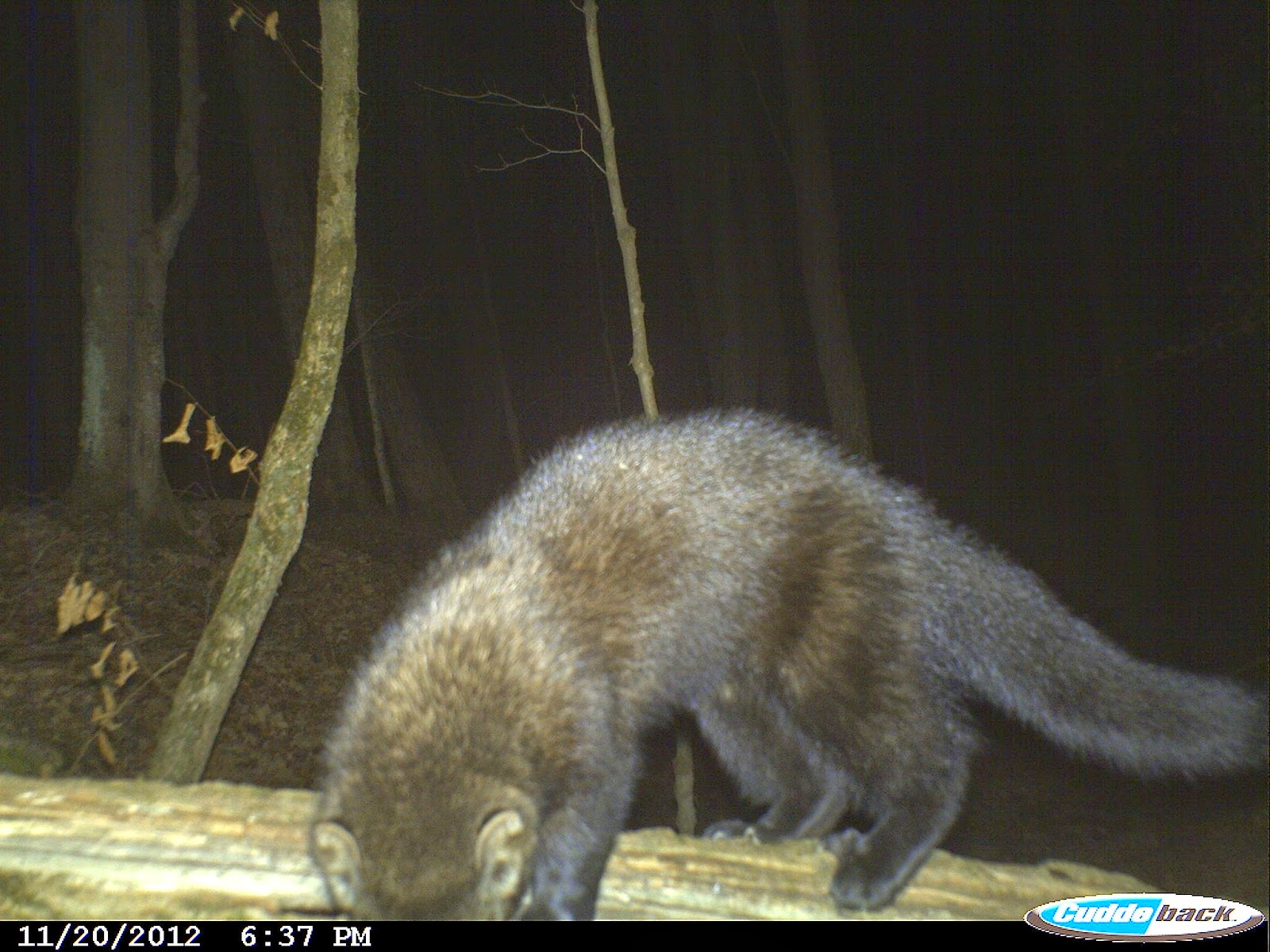
owns about 80 acres of forest and field in the town of Fremont, NY and each fall semester I put out ten camera traps in hopes of capturing images of black bears. Two weeks later, I bring my Black Bear Management class to the property and we retrieve the cameras and look for signs of bear. We did succeed in capturing a (single) image of a black bear but the real star of the show this year was fisher.
Fisher are recent additions to the fauna of that area. In 2012, I saw a fisher from my tree stand and decided that day I would try a camera trap set to capture an image. There is a small gully on the property with a fallen tree acting as a natural bridge. I reasoned that this was a perfect location for a fisher to travel. I was right, It only took 36 hours to capture a fisher with my Cuddeback camera. And it didn't take long to get a second photo:
Fisher crossing log
11/12, Fremont, NY
Since then, fisher have shown up regularly on my cameras. They really are rapidly expanding their range in our part of New York State. Most of my students have never seen one and many do not live in areas where fisher are common yet. So although we are targeting black bears in this particular project, the fisher photos are welcomed by all.
To increase our chances of bear captures, we set out ten (or so) cameras for two weeks in a variety of situations including game trails, mowed paths and likely looking locations on the landscape. But the
Adding lure to a rotting log
secret weapon has been the use of a commercially available lure called Ultimate Bear Lure by a company called Wildlife Research Center. This sweet-smelling lure has brought bears to the cameras in the past but we also get other animals like red fox, raccoon and even deer sniffing at the lure. And of course, fisher. At left is a photo of me taking a minute out of my turkey hunting to freshen up the scent at this set. I chose this location because I believe the rotting log holds the scent better than just pouring it into the ground. Besides, that's my Dad's hunting blind in the background and this set can serve double duty by scouting for deer.

Although no bears appeared at this set, we did capture a fisher marking over the scent. According to Elbroch and Rinehart (2011), fisher will rub their bellies to scent mark. The Reconyx camera at this set took several bursts of ten images that work almost as a video. Have a look:
This was an exciting capture for me. I love documenting a behavior or other aspect of an animal's natural history. This particular scent marking was new to me, and I was excited to read about it. It wasn't long before I was able to put this new knowledge into practice.

Fisher tracks in fresh snow
11/12, Fremont, NY
I started this blog entry by talking of two autumn traditions. The first was setting camera traps for my bear class and the other is hunting with my Father. This year's deer season didn't produce many deer but was productive in other ways. Last weekend, while heading to my hunting spot, I found fisher tracks. It has snowed overnight so these were very fresh tracks. I wondered if the fisher visited that tree to scent mark. I couldn't detect any odor though. I back tracked this fisher for a few hundred yards. A typical gait for fisher is a lope. Here, the fisher loped down the center of the trail and was straddled by Dad's ATV.

Fisher tracks
Fisher are members of the weasel family and have five toes on each foot. 

That night, it snowed again. Maybe an inch, maybe less. In the morning I returned to my deer stand only to find fresh fisher tracks on top of the fisher trail from yesterday. I had questions! Was this the same fisher or another? Why would it retrace its own steps from the night before? Or was he following MY footsteps? Was this another fisher discovering an intruder? All these questions remain
Fisher scent marking
11/14, Fremont, NY
unanswered. As I followed fresh fisher tracks for the second time in two days, I found myself crossing the ATV trail. But this time the fisher did not walk across the trail. It dragged its belly in a scent marking behavior. I have to admit that for a moment I wondered if I was looking at an otter slide. But it was fisher. A fisher doing the same thing in the snow as the one on camera did on the log. In fact, given the large home ranges of fisher, this is most probably the same fisher as the one photographed. I took several pictures of this marking from different angles:


Above, you can see the imprints that the rear legs left when it shuffled its belly along the ground.

Fisher tracks
11/14, Fremont, Wayland NY

Fisher scent marking
11/14, Fremont NY
This fisher was in the mood to scent mark. Whereas I followed the fisher the day before for over 300 yards and did not find a single scent marking behavior, the fisher trail on this day showed numerous scenting. I found four scent marks within 20 yards of the ATV trail. I could not detect an oder at any of them (although I was stuffed up from a cold). Why the difference? I am left to wonder if somehow I influenced the fisher's behavior. Was the marking due to my footprints (and scent) or was this truly a second fisher marking over an intruder? It is questions like these that make camera trapping and tracking so enjoyable.

Tuesday, November 11, 2014

Tracking in Rocky Mountain National Park

I had the opportunity to visit Rocky Mountain National Park (RMNP) around a business meeting I attended in Denver. When I arrived, the weather was sunny and 65F. On my final day, it was 5F and
Balmy November day at RMNP
Estes Park, CO (11/14)
had snowed during the night. My goal - dream really - was to get into the park early and drive the roads slowly to find a set of mountain lion tracks that cut the road. This is a common technique for finding tracks (and the cats themselves) but the fresh snow was a mixed blessing. On the one hand, anything I found would be absolutely recent (the nearest I could tell the snow had stopped around midnight), but on the other hand it meant that I would ONLY be finding tracks made in the last eight hours. That was going to make my task a long shot. Spoiler alert: I found no cat tracks. But I did have some interesting tracking experiences. Let me share two:

Rocky Mountain National Park
Estes Park, CO (11/14)
I wasn't the first to make it into the park today, I was the third. I followed two sets of tire tracks from the park entrance and slowly made my way through the snowy winterland. A pair of coyote trails followed the road for a while and I kept one eye on the distinctive side trot pattern and the other eye on the fresh snow looking for other tracks (that leaves no eyes for the road for those of you counting...). Despite my scrutiny of the road shoulders, it was a scene in a field that caught my eye. As you can see in the photo, everything was covered in a fine powder so when I saw something that WASN'T white, it stood out immediately.


These elk trails in the grass were so obvious to me but I wonder how many similar scenes I had missed over the years when I was less attuned to wildlife sign. I pulled the rental car over and snapped a few photos:

Elk trails in the snow
RMNP (11/14)

The tracks were easy to find as they crossed the road. I took a tracking class a few years ago and David Moskowitz was one of the instructors. He is the author of Wildlife of the Pacific Northwest and describes elk tracks as hamburger buns. As a long time burger-eater, I concur:
Fresh elk tracks
RMNP (11/14)
Here is a photo of the trail:

One even scatted for me:

So I had the trails coming towards me and I had the fresh tracks on the road in front of me. All that was left was for me to look at the direction the traveled. Sure enough, I only had to lift my head to see elk.
Elk
RMNP 11/14)
Elk
RMNP, (11/14)
There were far more elk above me than the tracks indicated. I looked ahead on the road and found more tracks and more trails. The story was complete.
Elk trails in fresh snow
RMNP, (11/14)
There was something very satisfying about this whole encounter. Reading sign that in this case, was verified by the individuals themselves. It was a simple story of a common animal, but I relished it nonetheless.:)

My second tracking story is more of a mystery. After driving the roads I layered up against the cold and started on a hike up Deer Mountain. The summit was a mere 3.1 miles away with a vertical gain of 1,080 feet. I was the only car parked at the trailhead. I brought the small lens instead of the telephoto as I was going to primarily take photos of wildlife tracks and sign. I spotted a nice variety of tracks including long-tailed weasel, elk, mule deer, snowshoe hare, mountain cottontail, chipmunk sp, red squirrel and perhaps one or two others that I have forgotten.

Here is a nice mule deer track to compare to the elk tracks above Not only are they smaller in size, but they are a different shape. Gone is the hamburger bun, replaced by a heart.
Mule deer track
RMNP, (11/14)
I enjoyed the solitude and the view. The trail switchbacked up into a sparse pine forest.
Deer Mountain Trail
RMNP (11/14)
Selfie
RMNP, (11/14)
As I neared the summit, I saw a snow-covered shape in the trail. My first thought was "That rock looks just like a rabbit." My second thought: "That is a rabbit."
Dead mountain or Nuttall's cottontail
RMNP, (11/14)
I cautiously brushed off some snow and saw that it had been killed by a wound to the throat. Weasels are known for that type of kill. Some of the flesh was eaten, but i will save you from the gruesome photos.
RMNP, (11/14)
Cause of death was a bite to the throat
RMNP, (11/14)
One member of the weasel family that could be a suspect here is the marten (Martes americanus). Here is a video I found of a marten killing a rabbit. But I had not seen any marten tracks. I HAD found long-tailed weasel tracks. Twice along this trail. The lack of blood would also be indicative of this weasel as they are known to lick up the blood from a kill. I am not certain the l-t weasel was the culprit, but since the snow had covered up the evidence, I was free to speculate and move on. So I did. And I only took a few steps when I noticed that the snow had not erased ALL the evidence. Look here:

This is a terrible photo looking back towards the dead rabbit. I wasn't paying attention to proper exposure, tricky when taking photos of snow. But if you look down the center of the photo, you can see that there is a trough under the snow. A furrow that had been snowed over, as if the rabbit had been dragged to its present location. Still can't see it? It runs the length of the photo, pretty much in the center. Let me try to darken the photo and see if that helps...


Well, on my monitor I can see the drag mark now. Here is another that I had to darken as well:


Here you can see rabbit tracks emerging from the left side of the photo and the start of the drag on the right side leading to the bottom right corner. I believe this is where the rabbit was killed. Could a long-tailed weasel drag a mountain cottontail 20 yards? Maybe. It was dragged downhill and there was a coating of snow present to help reduce friction. The fresh snow made it impossible to tell the whole story. But I enjoyed trying to puzzle it out. I left the rabbit where I found it. I wonder what the next hiker will find.